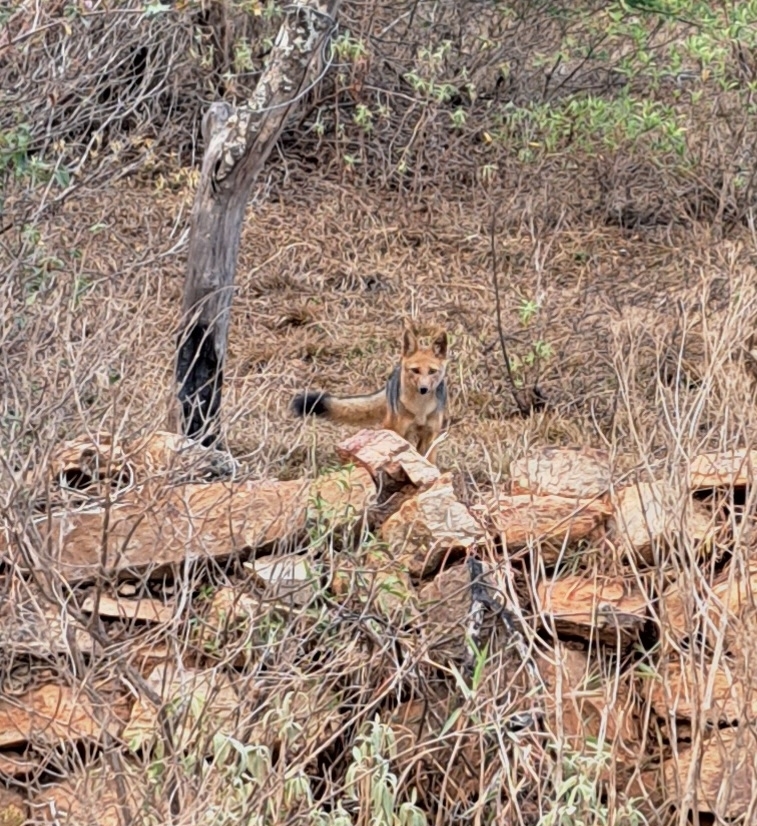
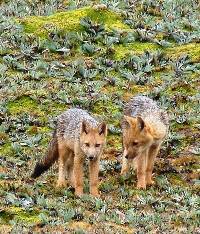
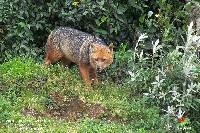
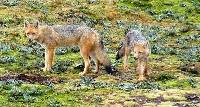
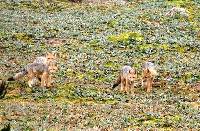
The culpeo (Lycalopex culpaeus), also known as Culpeo zorro, Andean zorro, Andean fox, Paramo wolf, Andean wolf, and colpeo fox, is a species of South American fox. Despite the name, it is not in the Vulpes, but more closely related to wolves and jackals. Its appearance resembles that of foxes due to convergent evolution.
The culpeo's diet consists largely of rodents, rabbits, birds and lizards, and to a lesser extent, plant material and carrion. They may prey on Andean flamingos and baby vicuña. The culpeo sometimes attacks farm animals, among them sheep, goats and poultry; for this, it is hunted in rural Chile and Argentina. In some regions, it has become rare, but overall the species is not threatened with extinction.
The culpeo was domesticated by the Selkʼnam people of Tierra del Fuego, producing the Fuegian dog which became extinct in the late 19th or early 20th century.
Description
Culpeo skull
The culpeo is a canid intermediate in size between a red fox and a coyote. It is the second-largest native canid on the continent after the maned wolf. In appearance, it bears many similarities to the widely recognized red fox. It has grey and reddish fur, a white chin, reddish legs and a stripe on its back that may be barely visible. The average weight of the male is 11.4 kg (25 lb), while the typically smaller females average 8.4 kg (19 lb). Overall, a weight range of 5 to 13.5 kg (11 to 30 lb) has been reported. Total length can range from 94 to 133 cm (37 to 52 in), including a tail of 32 to 44 cm (13 to 17 in) in length. The pelt has a grizzled appearance. The neck and shoulders are often tawny to rufous in color, while the upper back is dark. The bushy tail has a black tip.
Range
The culpeo's range extends from the southern regions of Patagonia and Tierra del Fuego in the south to Ecuador and Peru in the north, with some populations extending into southern Colombia. It is also found in the Sierras Grandes mountain range...