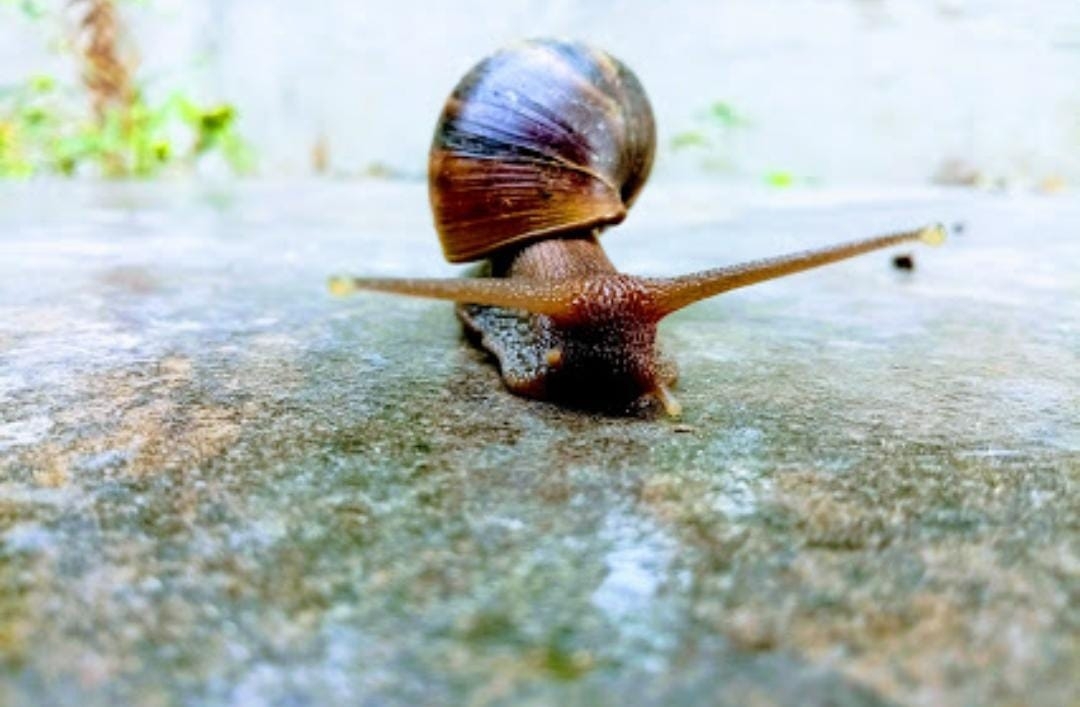
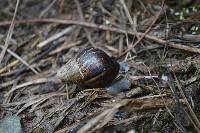
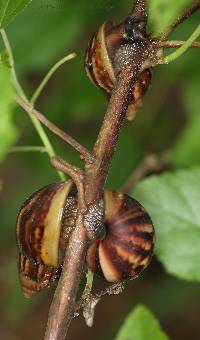
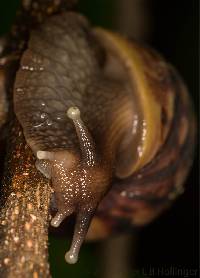
Lissachatina fulica is a species of large land snail that belongs in the subfamily Achatininae of the family Achatinidae. It is also known as the giant African land snail. It shares the common name "giant African snail" with other species of snails such as Achatina achatina and Archachatina marginata. This snail species has been considered a significant cause of pest issues around the world. It is a federally prohibited species in the U.S., as it is illegal to sell or possess. Internationally, it is the most frequently occurring invasive species of snail.
Outside of its native range, this snail thrives in many types of habitat with mild climates. It feeds voraciously and is a vector for plant pathogens, causing severe damage to agricultural crops and native plants. It competes with native snail taxa, is a nuisance pest of urban areas, and spreads human disease.
Subspecies
Subspecies within this species:
L. f. castanea (Lamarck, 1822)
L. f. coloba (Pilsbry, 1904)
L. f. hamillei (Petit, 1859)
L. f. rodatzi (Dunker, 1852)
L. f. umbilicata (Nevill, 1879)
Distribution
The species is native to East Africa, but it has been widely introduced to other parts of the world through the pet trade, as a food resource, and by accidental introduction.
Within Africa, the snail can be found along the eastern coast of South Africa, extending northward into Somalia. However, some of its distribution into northern Africa may be due to human introduction, starting in northern Mozambique, Tanzania, Kenya, and extending through Somalia into Ethiopia. The snail has been reported in Morocco, Ghana, and the Ivory Coast as early as the 1980s.
In 1961, Albert R. Mead, published the seminal work entitled "The Giant African Snail: A Problem in Economic Malacology". This book compiled known information on the snail, as well as a detailed overview on its global distribution.
Prior to 1800, the snail was found in Madagascar, spreading westward to Mauritius, reaching Réunion in 1821, then to...