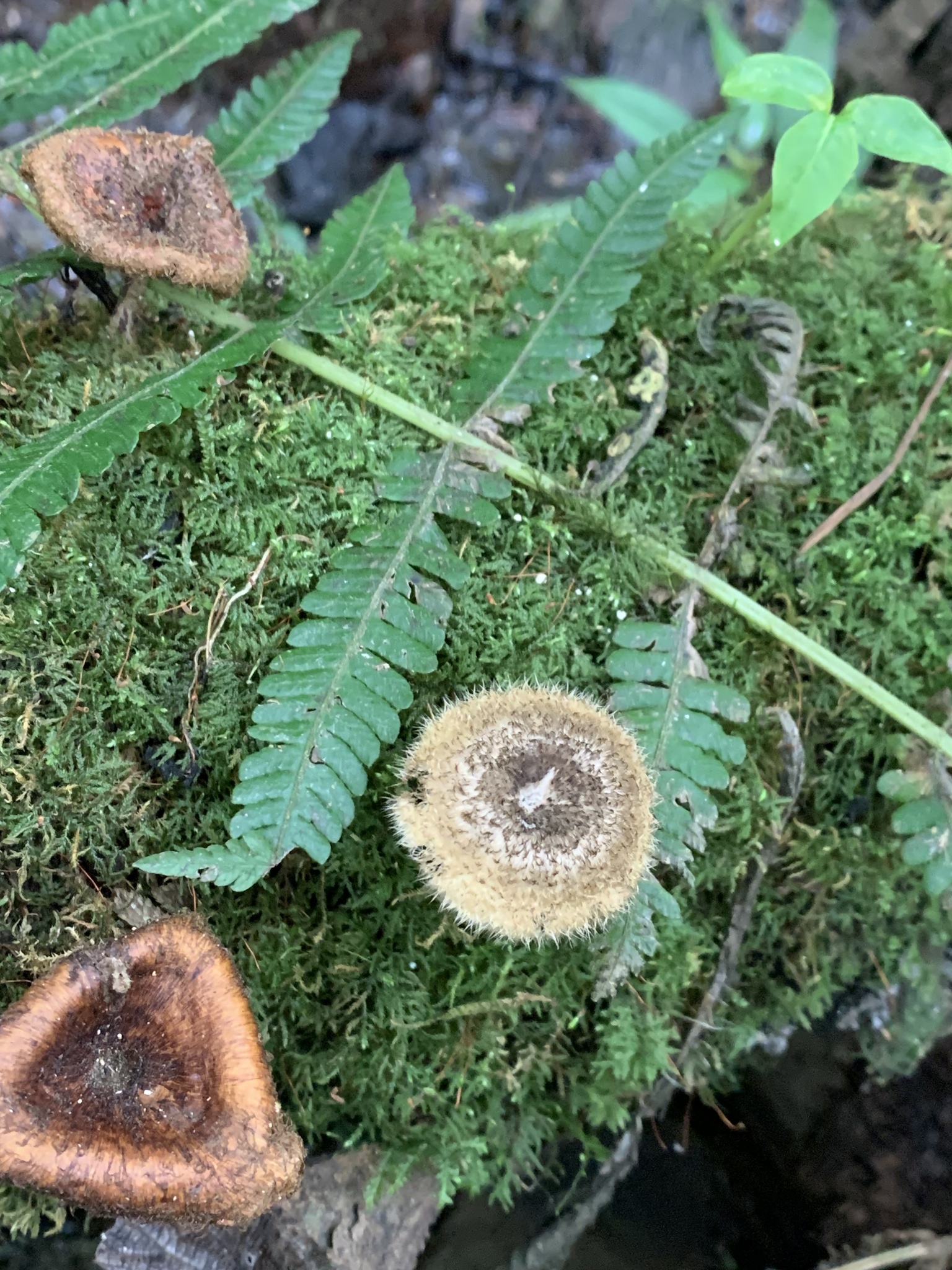
Lentinus crinitus, the fringed sawgill, is a basidiomycete species of fungus.
Taxonomy
It is in the subdivision Agaricomycotina, the order Polyporales and in the family Polyporaceae, within the group Polyporellus. There are many synonyms including Agaricus essequeboensis, Lentinus chaetoloma, L. essequeboensis, L. microloma, L. rigidulus, L. subcervinus, Curtis, L. wrightii, Panus crinitus, Panus wrightii, Polyporus phyllostipes, and Agaricus crinitus.
This fungus was first described by Carl Linnaeus, and reported and identified by Elias Magnus Fries in 1825.
The closest relative is to L. crinitus is Lentinus swartzii and the closest genus is Polyporus with Ganoderma being closely related as well.
It has been included in multiple phylogenetic studies.
Lentinus crinitus appears to form a single mating group. In fungi, a single mating group means that a species has one mating type, or that it is homothallic. This means that the species can mate with itself, or reproduce asexually.
Description
The fruiting bodies commonly grow in irregular, clustered formations. The cap is
The stipe can be 2–4.5 cm long and 2–6 mm thick, usually having a small bulb at the base. The stipe is not hollow, has a somewhat roughened surface and a leathery feel. The stipe is lighter in color than the cap but the same color profile. The gills extend slightly down the stem (decurrent), are narrow, somewhat forked, and finely toothed (denticulate), with a glandular surface. They appear in shades from pale to dark fuscous, sometimes featuring yellowish-brown hairs along the edges. The stipe, measuring 1–4.5 cm long, can be central or off-center (eccentric) in relation to the cap, cylindrical, and leathery in texture, with a covering of light yellow scaly hairs (squamulose) and darker scales (squamules).
The basidiospores are white in and usually range between 5.5 and 8.0 × 1.8–3.0. The spores are rounded...